10 October 2026
Stack Parking Meaning, Types and How It Works
Key takeaways
- Meaning: stack parking (also called a car stacker, stack parker or G+1 / G+2 system) parks 2 or 3 cars in one bay by lifting a platform.
- Types: 2-post or 4-post frames, 2 levels or 3 levels, above ground or with one level in a pit. The names change between makers; the machine is the same family.
- How it works: drive on, step off, press the button; a hydraulic cylinder or motor lifts the platform and a mechanical lock holds it. The second car parks below.
- The one rule: a standard stack parking system is dependent. Plan it for cars that belong to the same owner, a valet or a dealer, not for strangers on different schedules.
- Height, not depth: a 2-level unit needs about 3.6 m of clear height for sedans and about 4.2 m for SUVs; a 3-level unit needs 5.4 m or more, unless one level sits in a pit.
What is stack parking?
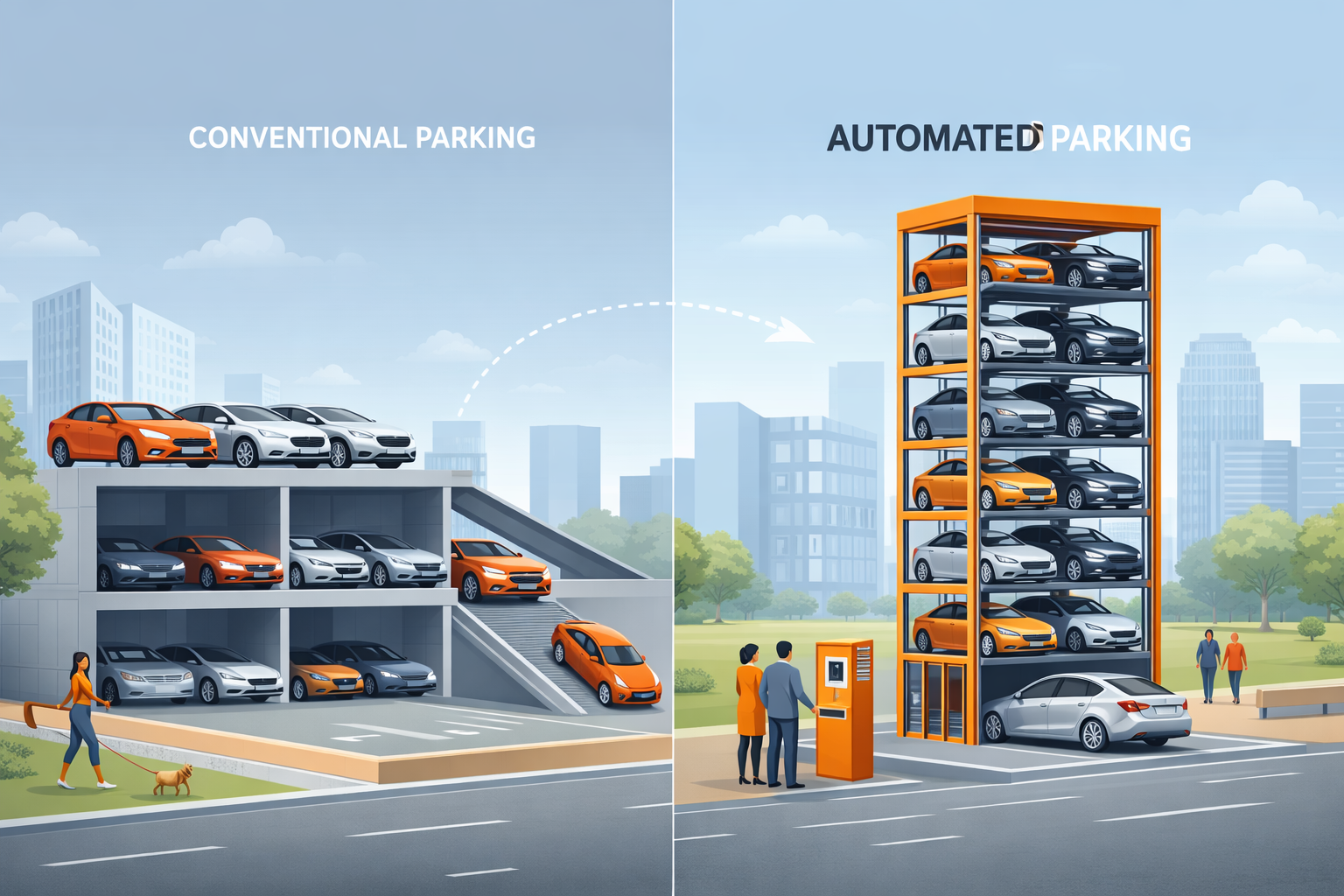
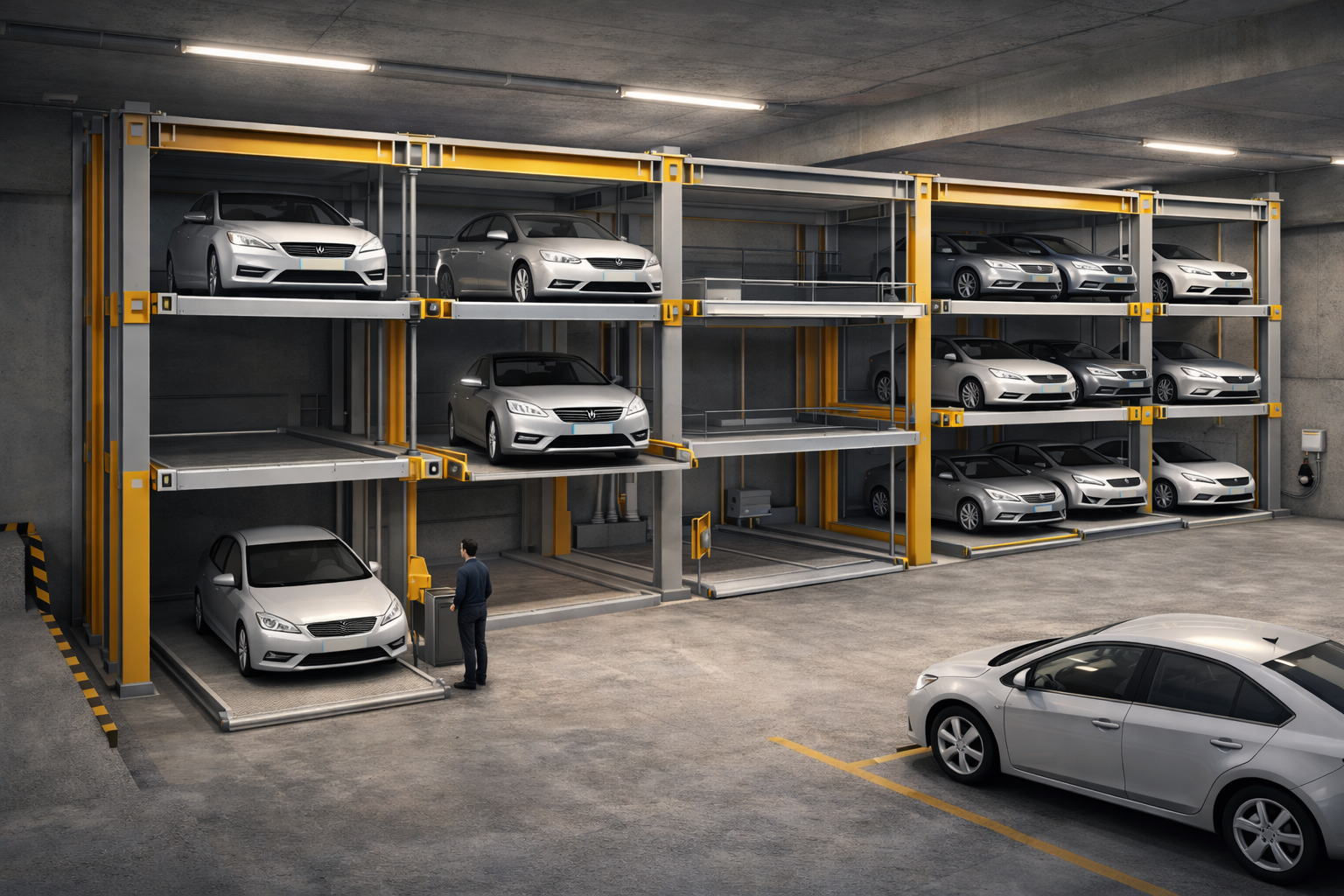
Stack parking is a mechanical parking system that parks two or three cars one above another in the floor space of one car. A steel platform on two or four posts lifts the first car up so the next car can park underneath. Most stack parking is dependent: the ground car must move before the upper car can come down.
The word “stack” means exactly what it says. The cars are stacked, one on top of the other, the way boxes are stacked on a shelf. The machine that does the stacking is a lift platform held by two or four steel posts, driven by a hydraulic cylinder or an electric motor. In India you will also hear it called a car stacker, a stack parker, a parking lift, or by its level count: G+1 (ground plus one, two cars) and G+2 (ground plus two, three cars).
Two things stack parking is not. It is not the American zoning term “stacked parking”, which means cars parked nose-to-tail in a long bay with no machine at all. And it is not a service lift from a workshop, even though a 4-post stacker looks like one. A stack parking system is built to hold a car for days, with locks at every level, and to be used by a driver, not a mechanic.
How does a stack parking system work?
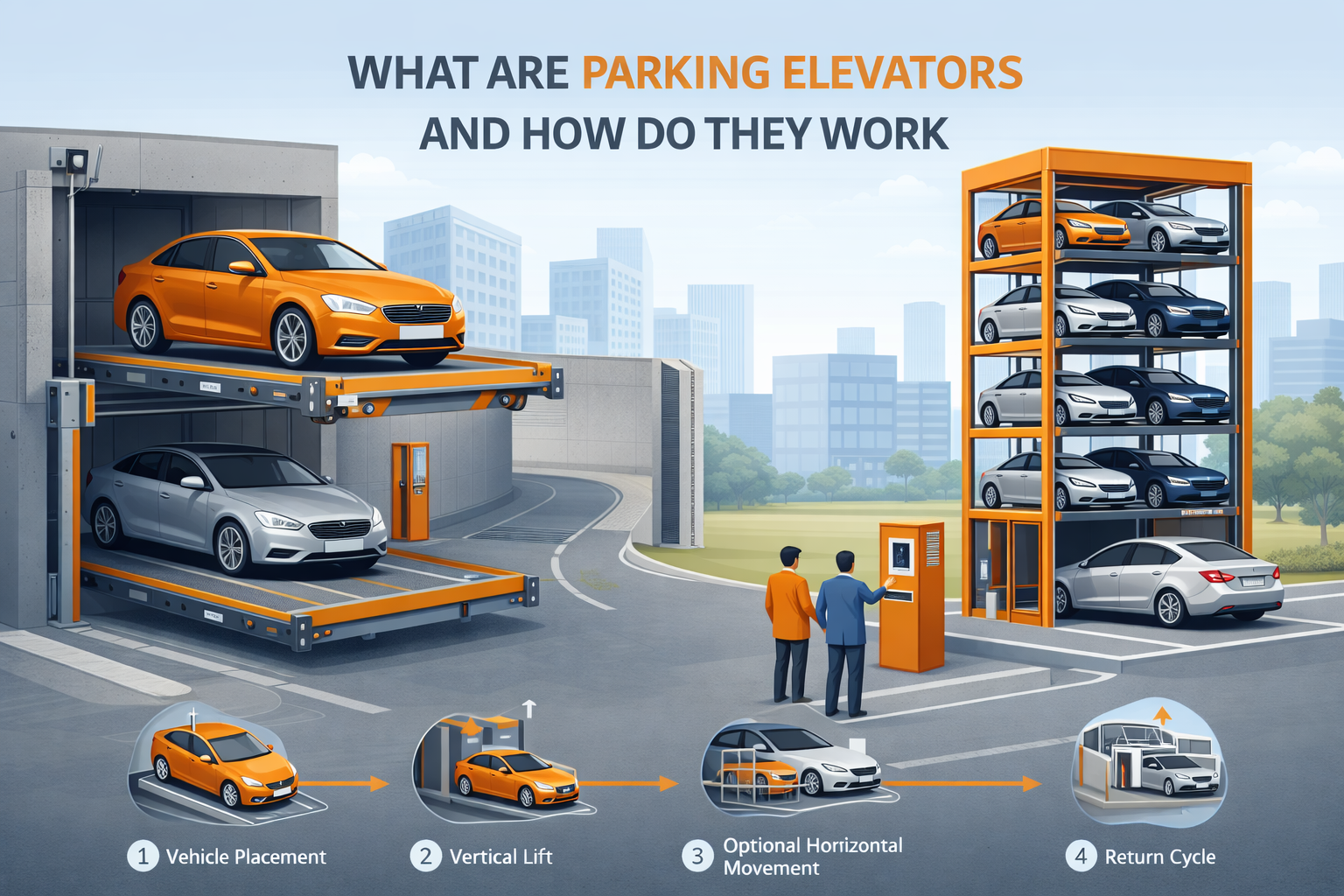
A stack parking system works in six steps: drive onto the platform, step off, press the lift button, let the mechanical lock engage, park the second car underneath, and reverse the order to get the upper car back. One cycle takes about a minute.
- Drive onto the platform. The platform sits at ground level with wheel stops at the front. Drive on slowly, centre the car, apply the handbrake and switch off.
- Step off and go to the control panel. Nobody stays in the car. The panel is a key switch or push button on one post. Only the key holder, a valet or a trained resident operates it.
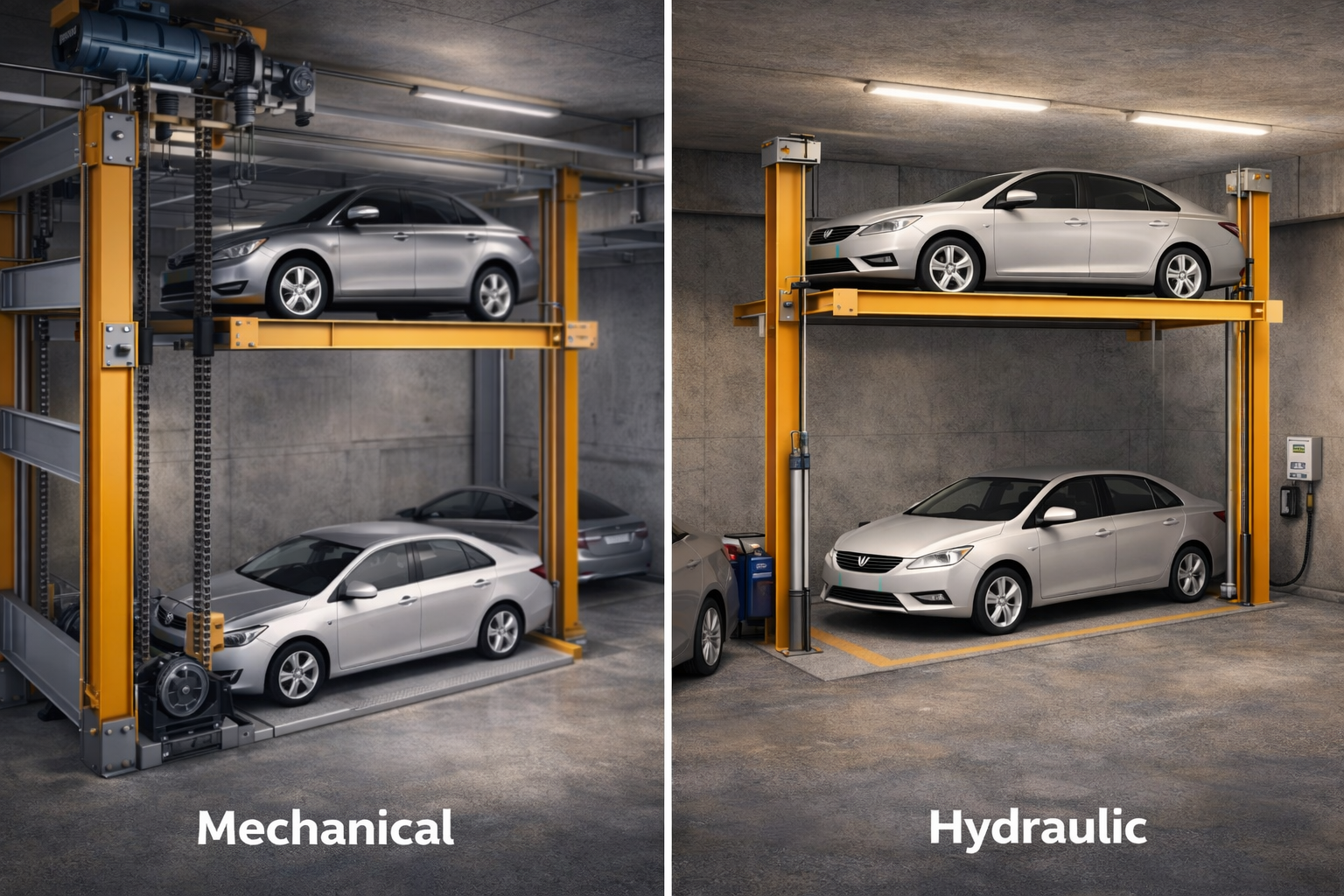
- Press “up”. In a hydraulic stack parking system, a power pack pumps oil into a cylinder and the cylinder pushes the platform up. In an electromechanical unit, a motor winds wire ropes or chains instead. Typical lifting speed is about 4 to 5 metres a minute, so the platform is up in roughly 30 to 45 seconds.
- The mechanical lock engages. At the top, steel locks drop into place on the posts. The platform now rests on the locks, not on oil pressure or the motor. It will stay up through a power cut.
- Park the second car underneath. The ground space is free. The second car parks on the floor below the raised platform, in the same bay.
- Reverse the order to retrieve. The ground car drives out. The operator presses “down”, sensors confirm the bay is clear, the locks release, and the platform lowers at a controlled speed. The upper car drives off.
What is inside a stack parking unit
- Posts: two or four steel columns bolted to the slab; they carry the whole load.
- Platform: a galvanised steel deck with wheel stops and a drive-on ramp.
- Drive: a hydraulic power pack and cylinder, or an electric motor with wire ropes or chains.
- Mechanical locks: anti-fall locks at every level that hold the platform without power.
- Safety valves and sensors: an overload or pressure-control valve, limit switches and a clear-bay sensor.
- Control panel: key switch or push button, with an emergency stop.
Hydraulic and electromechanical drives both work well. Hydraulic units are quieter and the more common choice for 2-post stack parking in India; motor-and-rope drives are often used on heavier 4-post frames. The hydraulic parking system page explains the drive difference in more detail.
Types of stack parking systems
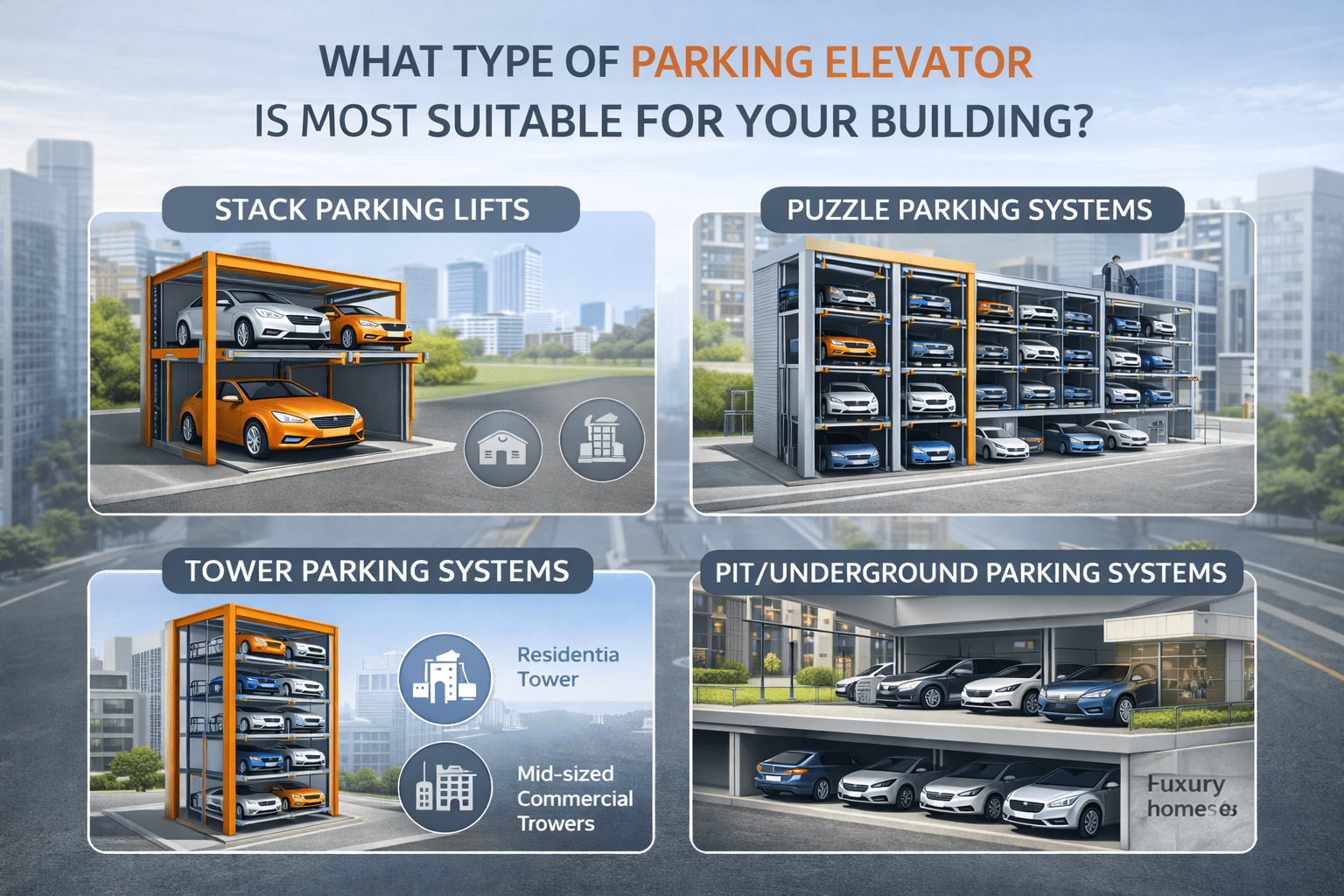
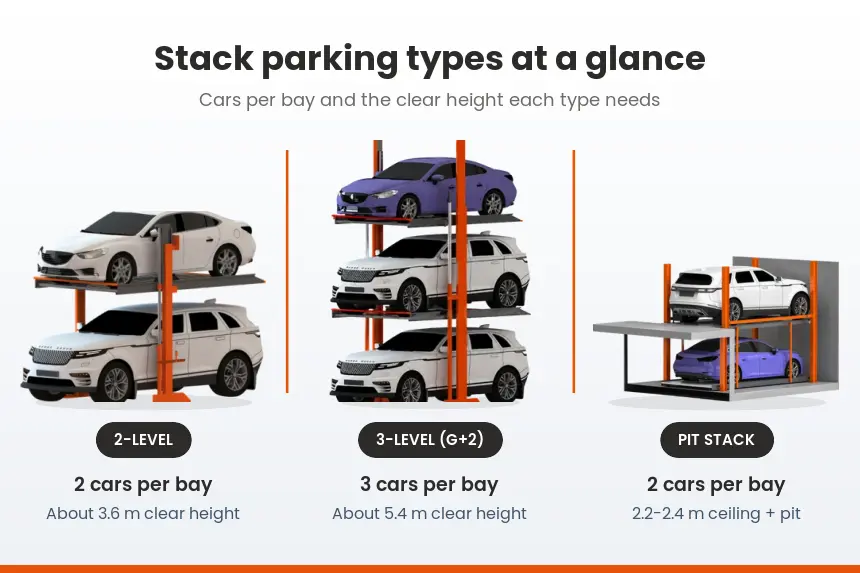
There are four stack parking system types you will be offered in India: 2-post 2-level, 4-post 2-level, 3-level (2-post or 4-post) and pit stack. Every maker uses its own model names, so the table below puts all the names side by side.
| Type | Also called | Cars per bay | Where the cars sit | Access | Clear height needed |
|---|---|---|---|---|---|
| 2-post 2-level | Double stacker, G+1, two-post car stacker, 2-pole parking lift | 2 | 1 on the ground, 1 above | Dependent | About 3.6 m (sedans) to 4.2 m (SUVs) |
| 4-post 2-level | Four-post parking lift, heavy-duty stacker | 2 | 1 on the ground, 1 above | Dependent | About 3.7 m to 4.2 m |
| 3-level (2-post or 4-post) | Triple stacker, G+2, 3 stack parking, three-level stack parking | 3 | 1 on the ground, 2 above | Dependent | About 5.4 m to 5.8 m |
| Pit stack (2 or 3 levels) | Pit parking, underground stacker, pit stacker | 2 or 3 | 1 below ground, 1 on the ground (and 1 above in a 3-level) | Dependent | About 2.2 m to 2.4 m above floor for 2 levels, plus a 1.8 m to 2.3 m pit |
Height bands are typical published figures from Indian and European supplier datasheets. The exact figure depends on the car heights you plan for, so confirm it on a site survey.
2-post 2-level stack parking
The most common unit in India, and the cheapest way to double a bay. Two posts at the back, one platform, two cars. It is also the easiest type to fit between existing basement columns. Single units take 2 cars and double-width units take 4, with load ratings of 2,000, 2,500 and 3,000 kg per platform, indoors or outdoors. See the 2-post 2-level stack parking system.
4-post 2-level stack parking
Four posts, one platform, two cars. It is heavier and more stable than a 2-post frame, so it suits SUVs, showrooms and places where the platform is used many times a day. Lifting is motor-driven with wire-rope balancing, with load ratings of 2,000, 2,500 and 3,000 kg. It needs a wider bay than a 2-post unit because the front posts take their own space. See the 4-post 2-level stack parking system.
3-level stack parking (G+2)
Two platforms above the ground car, so three cars share one bay. Three level stack parking is also sold as “3 stack parking” or a triple stacker, in both 2-post and 4-post frames, with load ratings of 2,000 and 2,500 kg per platform. It is fully dependent, so the cars come out in order, and it needs roughly 5.4 m of clear height above ground. That is why many 3-level units go partly into a pit. See the 4-post 3-level stack parking system.
Pit stack parking
One car goes down into a waterproof concrete pit, so the bay needs much less height above the floor. This is the stack parking type for podiums, stilts and basements with a height cap. A 2-level pit unit needs about a 1.8 m pit under a standard ceiling; a 3-level unit needs about 2.0 to 2.3 m of pit plus about 3.75 m above it. The trade is civil work: the pit, a sump and drainage. See the pit parking system.
2-post vs 4-post stack parking: which do you need?
Choose a 2-post unit when the bay is narrow and the cars are sedans or compact SUVs. Choose 4-post stack parking when the cars are heavy, the platform will cycle many times a day, or you want the extra stability of four columns.
| Point | 2-post stack parking | 4-post stack parking |
|---|---|---|
| Structure | Two posts at the rear; the platform cantilevers forward | Four posts, one at each corner; the platform is supported on all sides |
| Typical load | 2,000 to 2,700 kg per platform | 2,500 to 3,600 kg per platform |
| Bay width | Narrower; fits between existing basement columns more often | Wider; the front posts need their own space |
| Car types | Hatchbacks, sedans, compact SUVs | Full-size SUVs and heavy cars |
| Best use | Societies, villas, small basements, valet rows | Showrooms, dealerships, heavy-use commercial basements |
| Cost | Lower | Higher: more steel and a stronger drive |
Both are dependent systems. Both come in 2-level and 3-level versions. The frame changes the load and the footprint, not the way the system works.
Is stack parking dependent or independent?
A standard stack parking system is dependent. Builders call this dependent parking. The platform can only come down when the ground space is empty, so the car parked below must drive out before the car on top can leave. This is the single most important fact to understand before you put stack parking on a plan.
Think of a one-lane driveway with two cars in it. The car at the back can only leave after the car in front moves. A dependent stacker is the same thing, turned on its side. It is a brilliant tool when both cars belong to one household, one office or one valet team, because that person can plan the order. It becomes a daily argument when the two slots are sold to two strangers who leave at different times.
Dependent stack parking works well when
- Both cars in the bay belong to the same flat, villa or company.
- A valet or security team parks and retrieves the cars.
- The cars are dealer stock, staff cars or a second car that moves rarely.
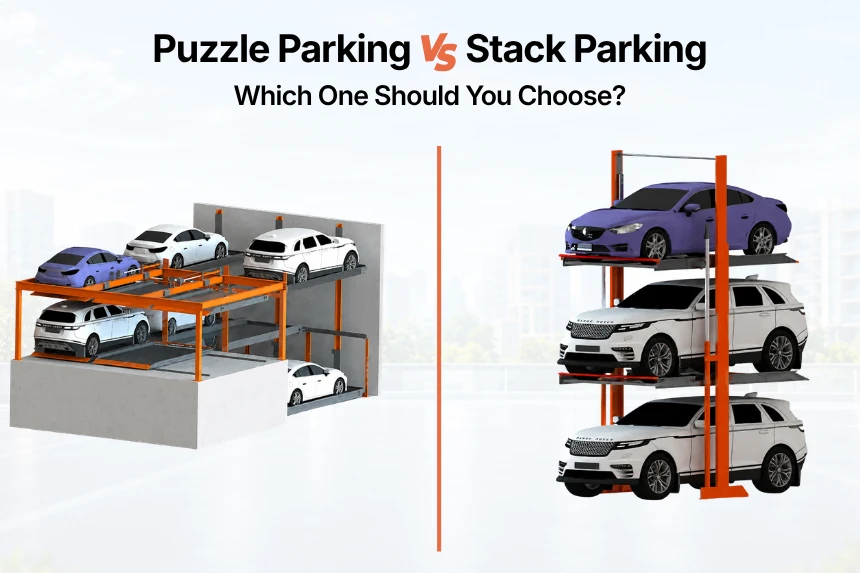
If every slot will go to a different owner with no valet, and residents expect to drive out at any hour, you want an independent system instead, where any car can come out without moving another. In India that usually means a puzzle layout. The full comparison is in puzzle parking vs stack parking, including the cost difference and a decision rule.
How much height does stack parking need?
A 2-level stack parking system needs about 3.6 m of clear height for two sedans and about 4.2 m for two SUVs. A 3-level unit above ground needs about 5.4 m to 5.8 m. If you do not have that height, a pit stack puts one car below the floor and brings the need down to a normal 2.2 m to 2.4 m ceiling.
The sum is simple: the height of the ground car, plus the height of the upper car, plus the platform thickness of about 15 to 20 cm, plus a top clearance of about 10 to 15 cm. Measure to the lowest beam, duct or sprinkler pipe, never to the slab.
Typical stack parking height by configuration
| Configuration | Cars | Clear height above floor | Pit | Where the figure comes from |
|---|---|---|---|---|
| 2-level, sedans (up to about 1.5 to 1.6 m tall) | 2 | 3.2 m to 3.6 m | None | Indian 2-post datasheets quote 3,200 mm for 1,500 mm cars and 3,600 mm as the usual minimum |
| 2-level, SUVs (up to about 1.9 to 2.0 m tall) | 2 | 4.0 m to 4.2 m | None | Indian supplier guidance for SUV-on-SUV stacking |
| 3-level above ground | 3 | 5.4 m to 5.8 m | None | Indian and European triple-stacker datasheets |
| 2-level pit stack | 2 | 2.2 m to 2.4 m | About 1.8 m | Indian supplier guidance |
| 3-level pit stack | 3 | 3.75 m (standard) to 4.35 m (comfort) | 2.0 m to 2.3 m | European 3-level pit stacker datasheet |
All figures are published supplier numbers, rounded. They are a planning guide, not a specification. A survey fixes the exact height for your car mix and beam depths.
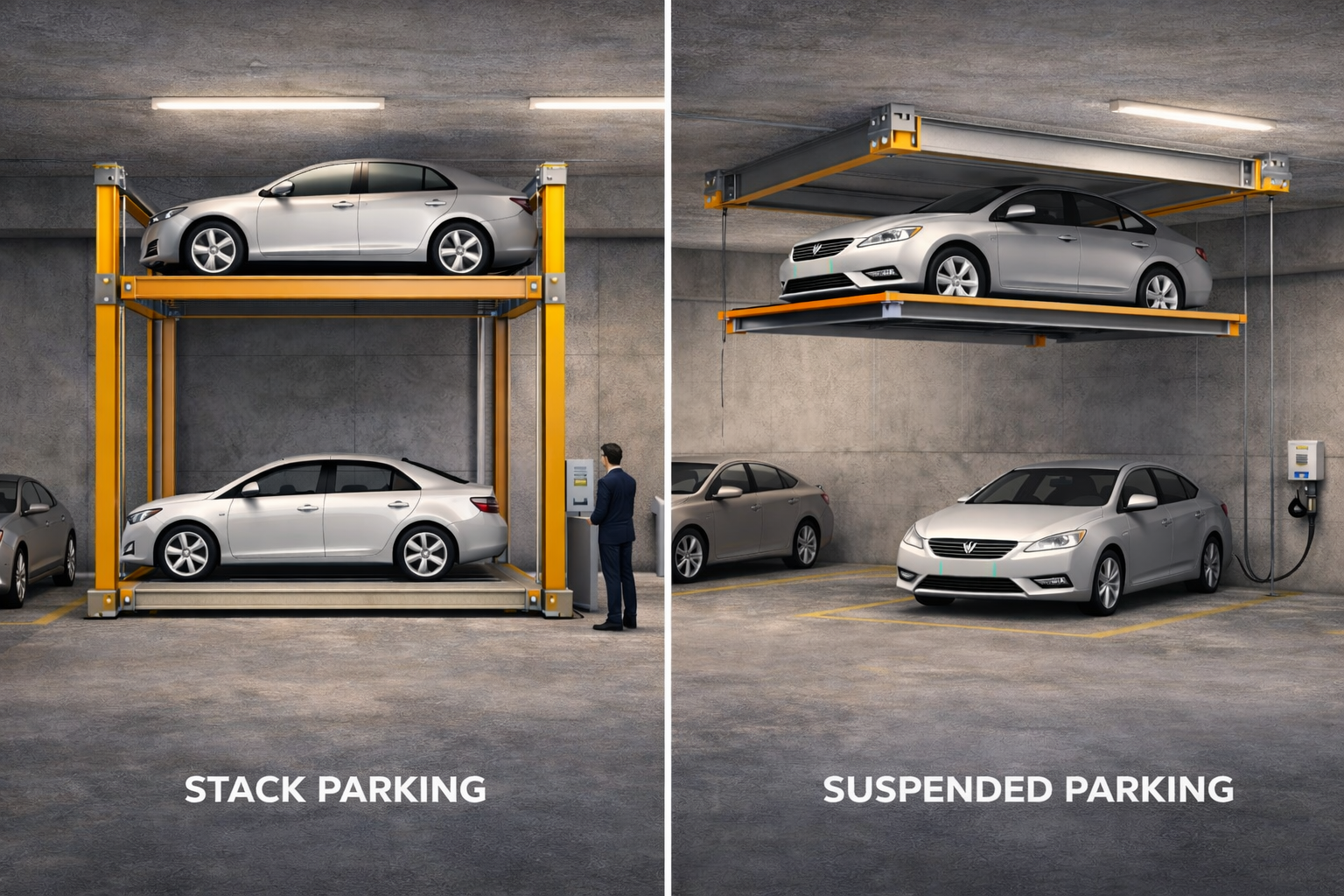
Height is the reason most stacker projects succeed or fail at the drawing stage. A basement cast at 3.0 m clear cannot take a 2-level stacker, and no vendor can fix that later. If the slab is already poured and the height is short, look at the pit parking system instead, or at a suspended unit, which hangs from the ceiling and is compared in stack vs suspended parking.
Book a free parking consultation
You can read the height bands above, but you cannot judge your own beam depths, column grid, car mix or sanctioned count from an article. We check that for you before you spend anything.
- A layout feasibility check on your parking plan, including which stack parking type fits each bay
- How many cars the plot can hold with 2-level, 3-level or pit stack units
- The right system for your project, with a line-item quote
Want a quick number first? Try the parking space calculator.
Is stack parking safe? Locks, power cuts and the fire rule
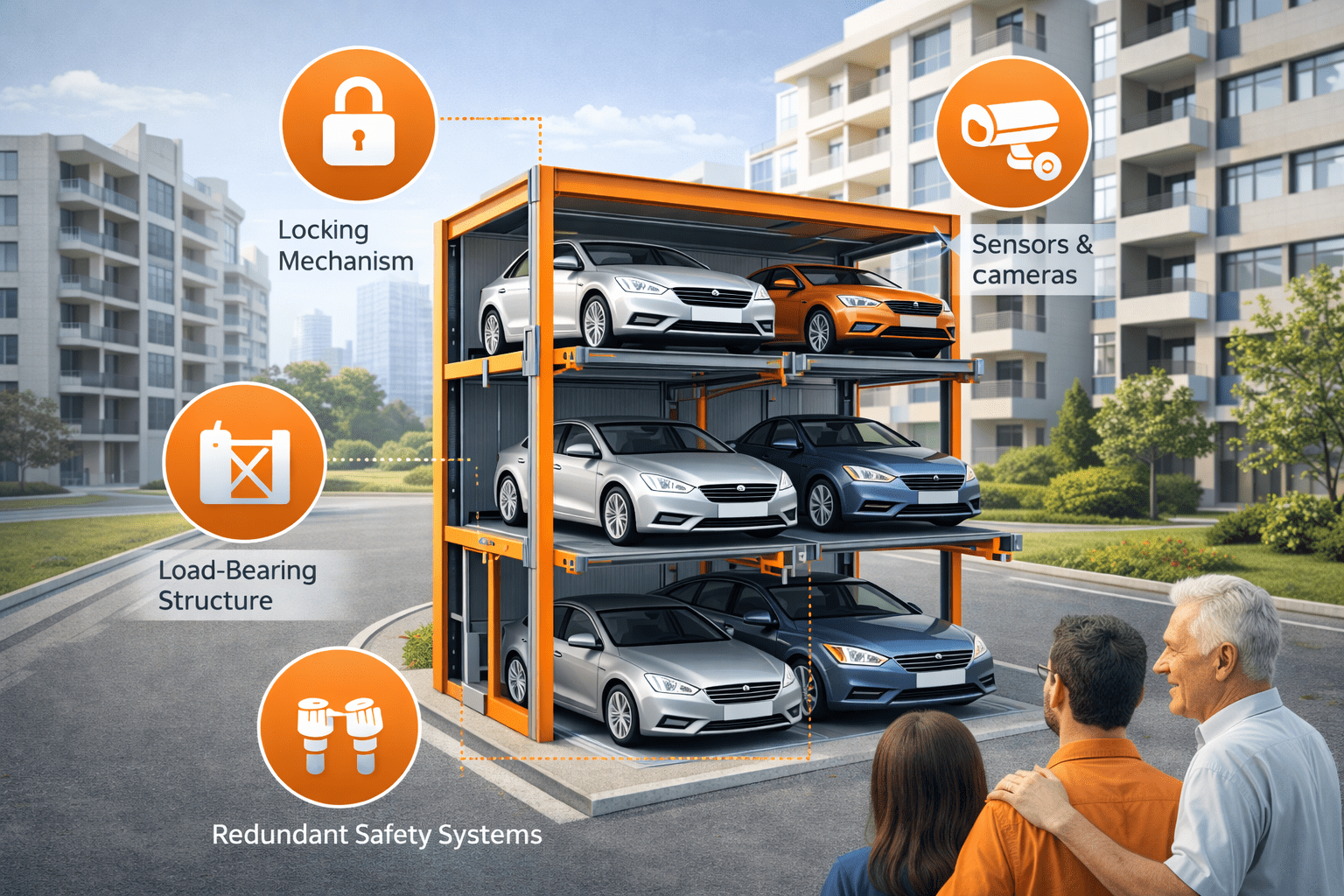
Yes, a properly built stack parking system is safe. The raised platform rests on mechanical anti-fall locks, not on hydraulic pressure, so it stays up in a power cut. An overload valve stops the lift if a car is too heavy, and sensors stop the platform from lowering onto a car below.
What happens in a power cut
Nothing moves. The locks hold the platform exactly where it is, and the ground car can still drive out. To bring the upper car down without power, the operator uses a hand pump or a manual release valve that lowers the platform slowly under control. Ask every supplier to show you this manual-lowering step before you buy.
The fire rule many Indian projects miss
Stacked cars sit close together, one above the other, so fire services treat them as a special case. The Maharashtra Directorate of Fire Services guideline for mechanised parking says that IS 15105, the normal sprinkler standard, does not cover car stackers. For stacked car parking it asks for quick-response sprinklers with a minimum of two heads per car, one above the bonnet and one above the boot, plus a one-hour fire rating on the stacker steel and decks and an emergency stop on the unit. Other states follow NBC 2016 Part 4. Check your local fire NOC conditions early, because sprinkler pipes also eat into your clear height.
Where is stack parking used?
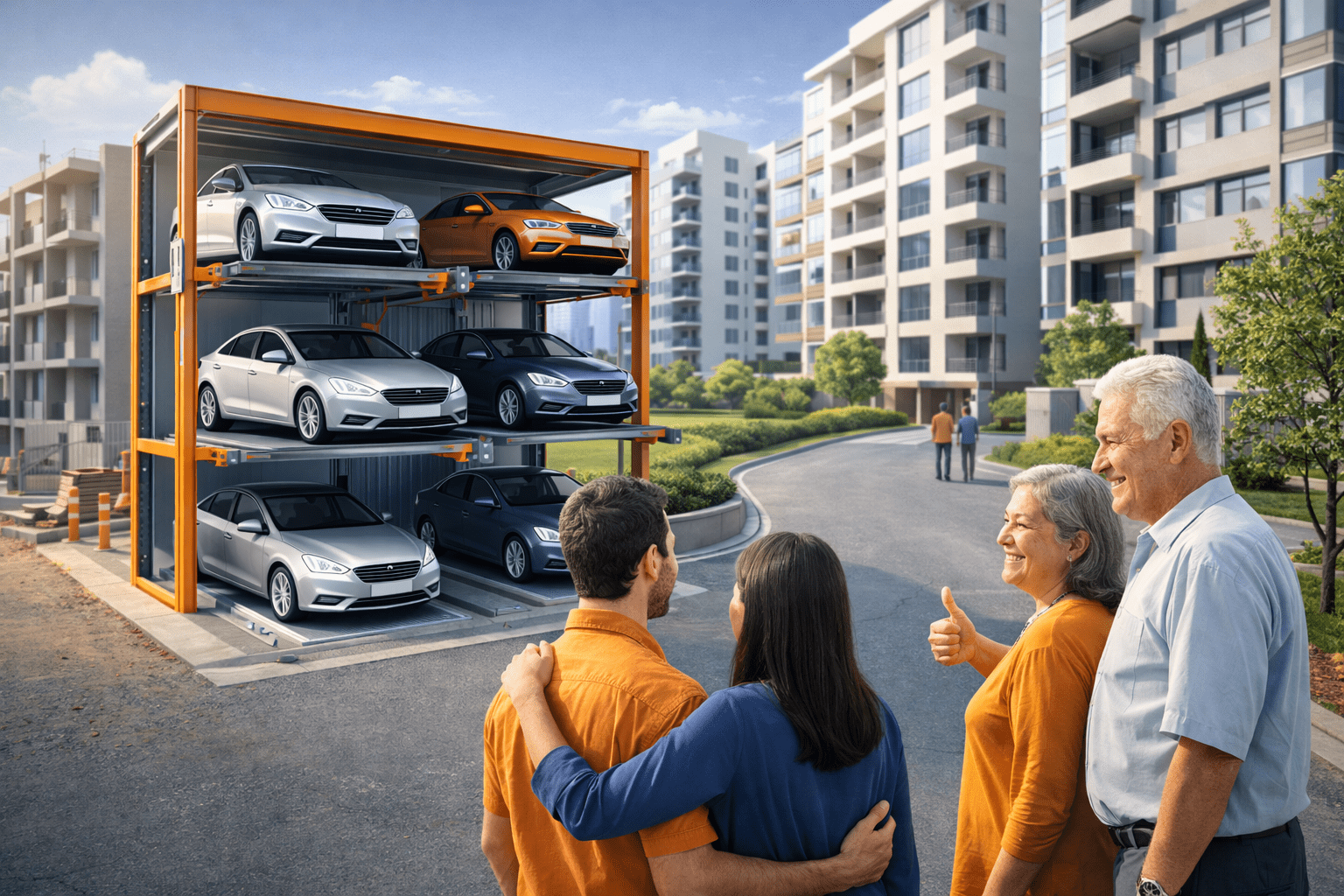
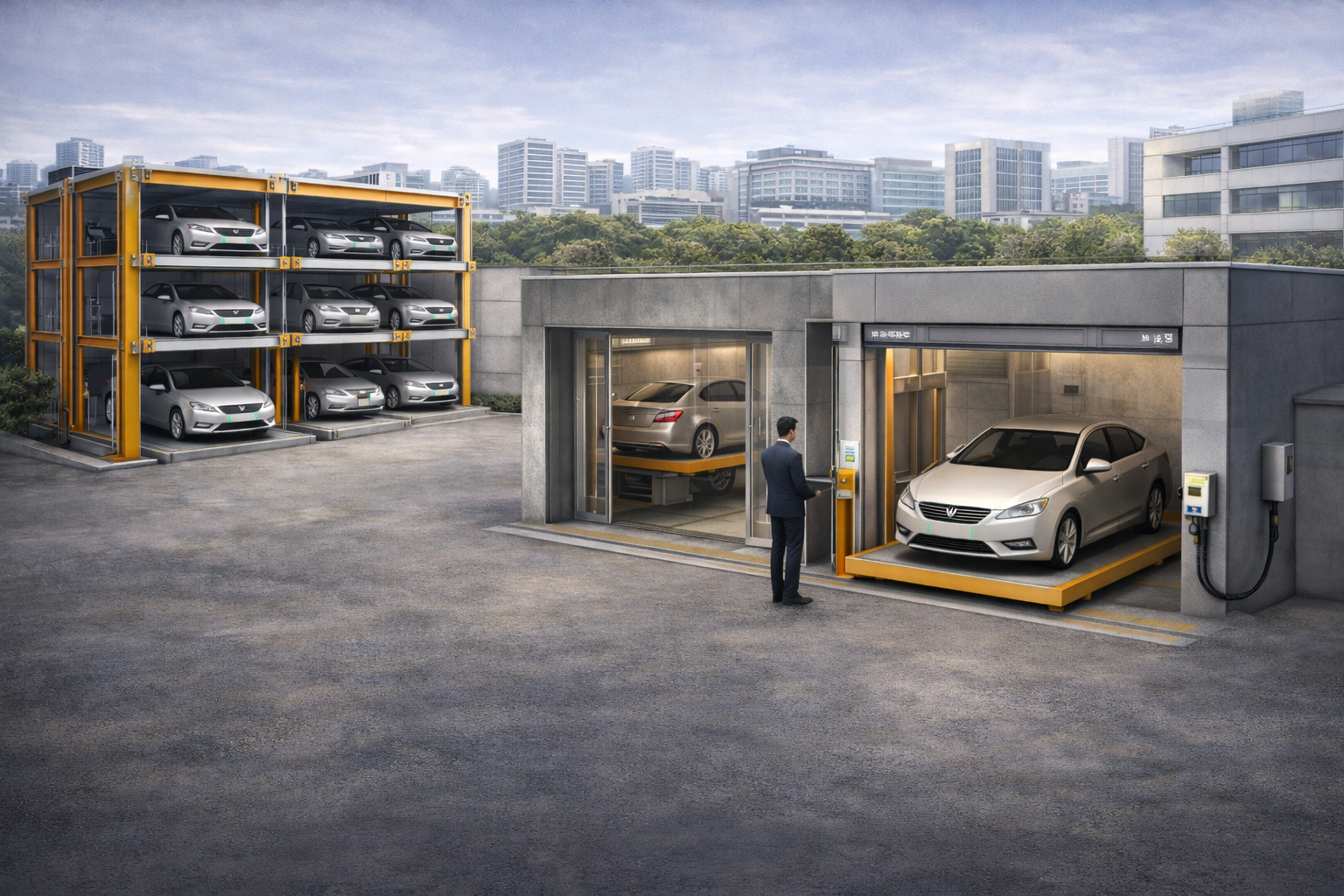
Stack parking is used wherever a building needs more car spaces than its floor area allows and the two cars in a bay can be managed by one owner or a valet. In India that is mainly housing societies, villas, car showrooms and commercial basements.
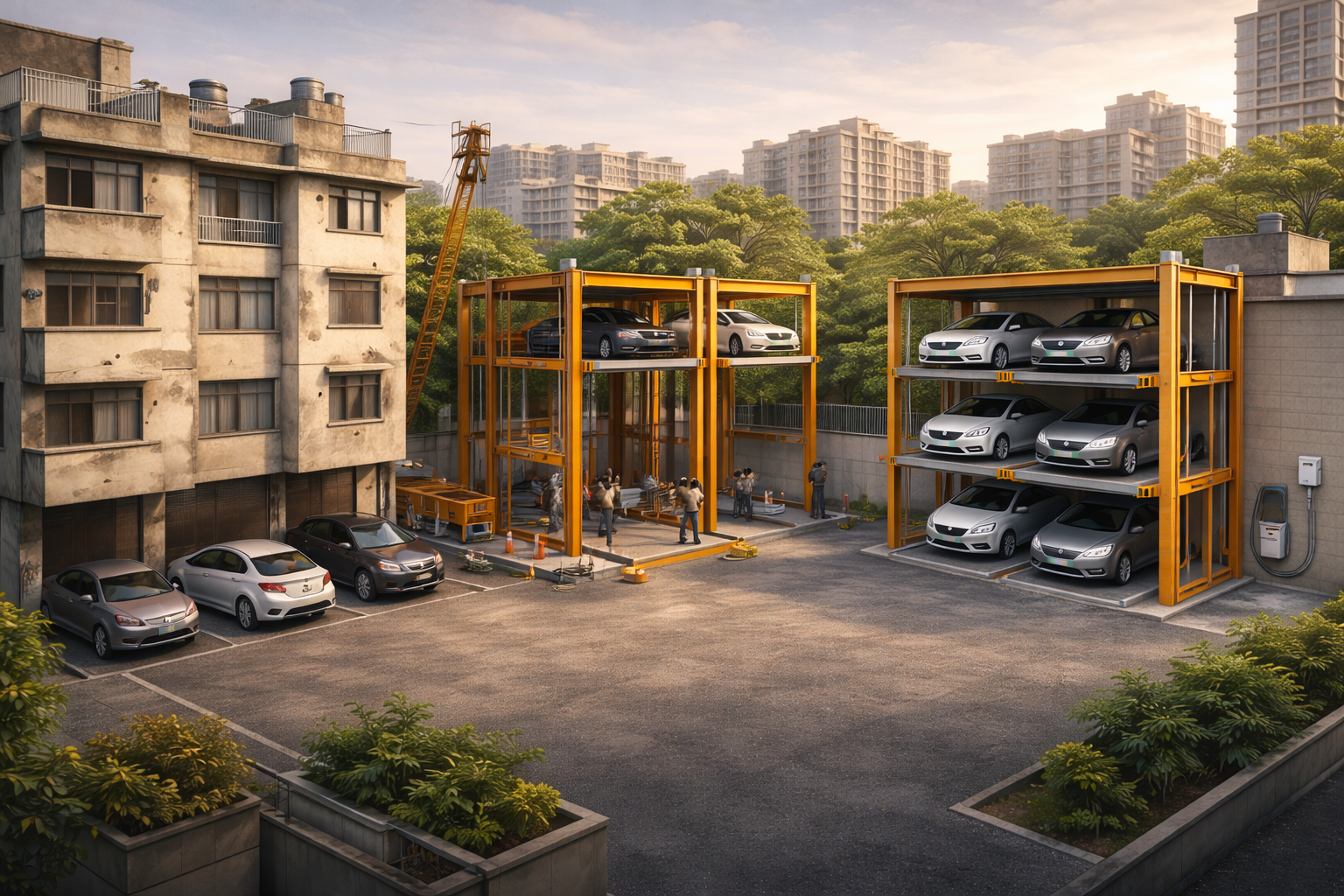
- Housing societies. The most common retrofit under stilts and in basements with 3.6 m or more of height. It works best when each unit is allotted to one flat with two cars.
- Villas and bungalows. A single 2-post unit turns a one-car garage into a two-car garage. The same family drives both cars, so dependent access is no problem.
- Car showrooms and dealers. Stock cars move rarely and a trained team operates the lift. 4-post units take the heavier models.
- Offices and commercial basements. Valet-run rows of 2-level or 3-level units double the count for staff and visitors.
- Hotels and public valet lots. Valet parking is dependent anyway, so a stacker adds capacity without changing how the lot runs.
- New projects short on sanctioned parking. When the by-law count cannot be met on the floor plate, mechanised bays are the usual answer. See the stack parking system page for the full range.
Does stack parking count for building approval in India?
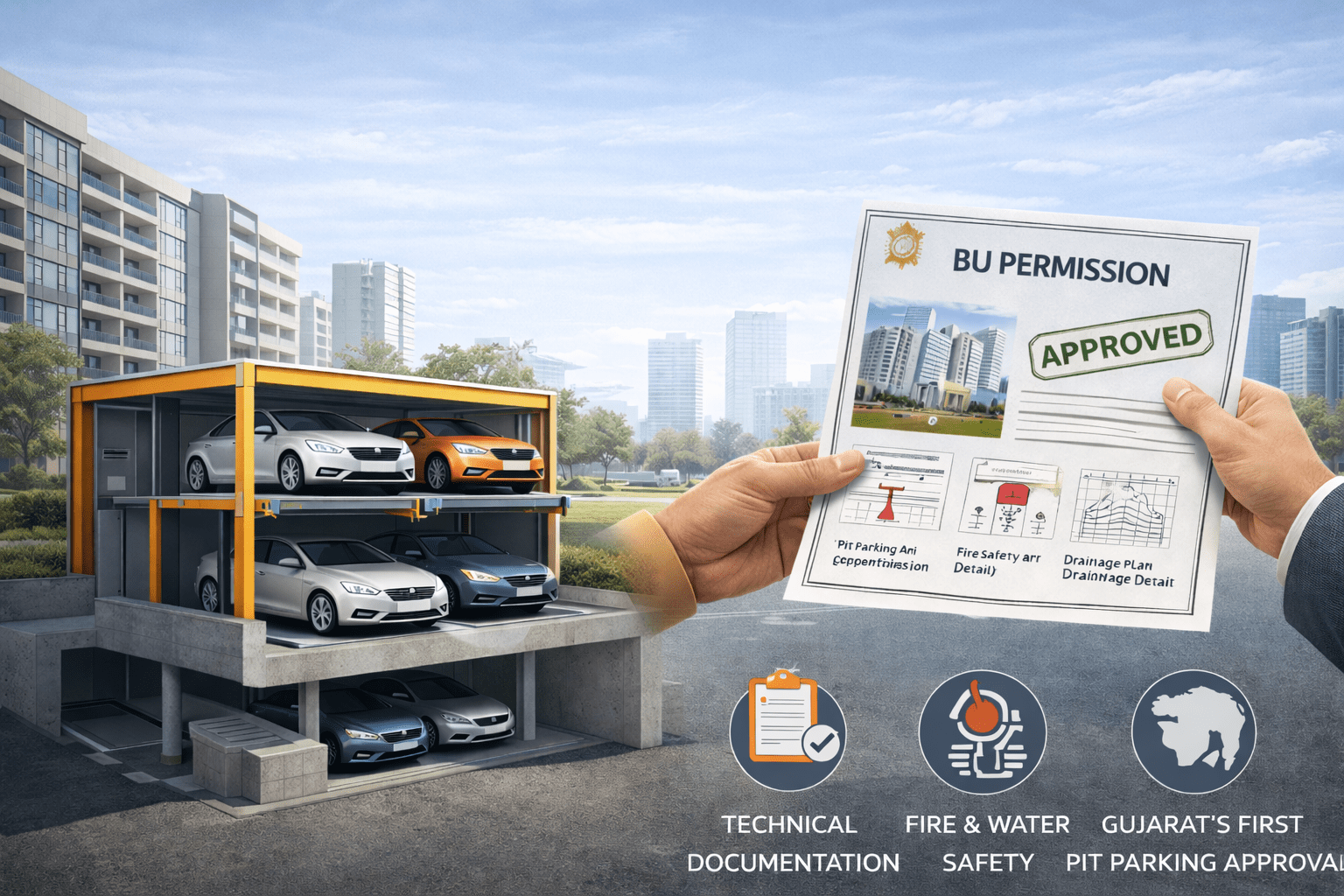
In most Indian cities, yes. Mechanised parking is a recognised way to meet the sanctioned parking count, so a stacker can close the gap between the spaces a plot gives you and the number the by-laws ask for. That is the main reason developers install one.
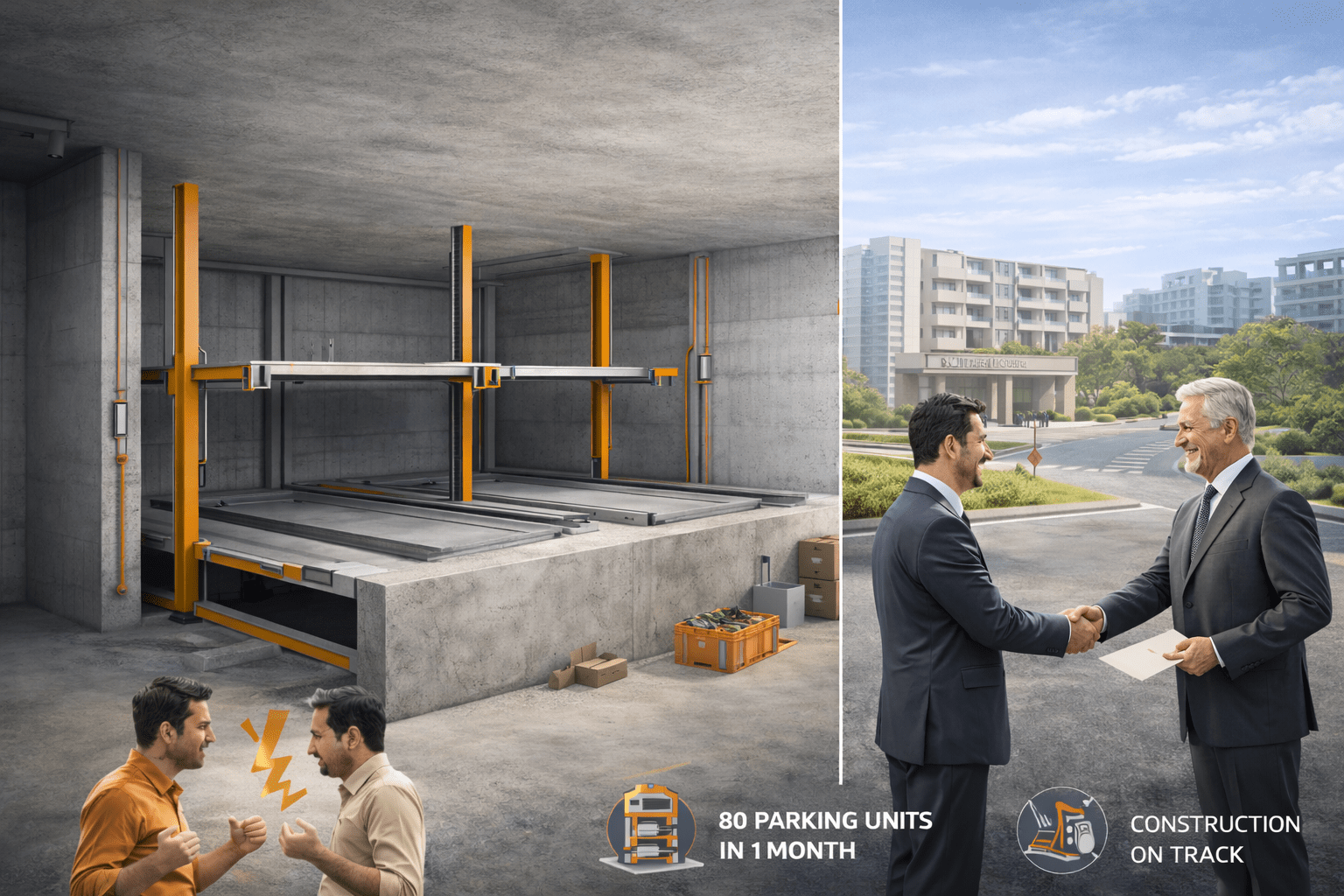
The rules set a minimum bay size rather than banning the system. The Maharashtra fire-services guideline for mechanised parking, for example, sets the minimum mechanised bay at 13.34 m² for big cars and 10.5 m² for small cars, which is what a stack parking bay is drawn to. Local development control rules differ from city to city, and the units usually have to be installed and working before the occupancy or building-use inspection, not promised on paper. i-CUBE’s Solitaire Connect project in Ahmedabad received BU permission within one month of the parking system going in.
Get the mechanised bays onto the sanctioned plan at the drawing stage. Adding them after the structure is cast is where projects lose both time and spaces.
What decides the cost of a stack parking system?
The cost of a stack parking system is decided by six things: the frame (2-post or 4-post), the number of levels, the load rating, the drive type, the civil and electrical work on site, and the quantity you order. Of all mechanical parking families, it has the lowest cost per extra car.
- Frame and levels. A 2-post 2-level unit is the entry point. A 4-post frame or a third level adds steel, a stronger drive and more installation time.
- Load rating. 2,000 kg platforms cost less than 2,500 kg or 3,000 kg SUV-rated platforms.
- Drive. Hydraulic and electromechanical units are priced differently; the choice also affects running cost.
- Civil and electrical. A pit, slab strengthening, the three-phase supply and sprinkler changes are site costs on top of the machine.
- Quantity. A row of ten units for a society prices lower per unit than one unit for a villa.
- Service. The annual maintenance contract and the supplier’s service network decide the cost of ownership, not just the purchase price.
We do not print a price here on purpose. Public listings in India show a very wide range for what looks like the same unit, because load, height and site work differ so much. The stack parking system page explains how a quote is built, and a free layout check gives you a number for your plot.
Why choose i-CUBE for your stack parking system
Stack parking is simple to describe and easy to get wrong on a drawing. The clear height, the bay width, the slab and the car mix all have to line up before anything is ordered.
8,000+ parking spaces delivered·105+ projects across India·Since 2015 designing and installing
i-CUBE Parking Elevators builds the full stack parking range in India: 2-post and 4-post frames, 2-level and 3-level versions, and platforms rated 2,000, 2,500 and 3,000 kg for sedans and SUVs, with pit stack units where the ceiling is low.
The company is empanelled with CREDAI and works as a consultant as much as a manufacturer. The survey comes first, then the layout, then the quote. If you are weighing stack parking for a society, a showroom or a new project, send us the plan and we will tell you which type fits and how many cars you gain.
Stack parking FAQ
What does stack parking mean?
Stack parking means parking two or three cars one above another in the floor space of one car, using a lift platform on steel posts. The platform raises the first car so the next car can park underneath. It is the simplest type of mechanical car parking.
What is a car stacker? Is it the same as stack parking?
Yes. A car stacker, a stack parker, a parking lift and a stack parking system all describe the same machine: a platform that lifts one car so another can park below it.
How does stack parking work in simple words?
You drive onto the platform, get out and press a button. A hydraulic cylinder or motor lifts the platform and a mechanical lock holds it up. A second car parks underneath. To get the top car, the bottom car drives out and the platform is lowered.
What is 3 stack parking or G+2 stack parking?
3 stack parking, also written G+2, is a three level stack parking unit: one car on the ground and two on platforms above it, so three cars share one bay. It is dependent, so the cars come out in order, and it needs about 5.4 m of clear height unless one level sits in a pit.
Is stack parking dependent or independent?
Standard stack parking is dependent: the ground car must move before the upper car can come down. Independent access needs a puzzle-type system, where platforms also slide sideways to free a path.
What is the minimum height for stack parking?
About 3.6 m of clear height for a 2-level unit with sedans, about 4.2 m with SUVs, and about 5.4 m for a 3-level unit above ground. A pit stack brings the above-floor need down to a normal 2.2 m to 2.4 m ceiling.
Which is better, 2-post or 4-post stack parking?
Neither is better in general. A 2-post unit is cheaper and fits narrower bays; a 4-post unit carries heavier cars and takes more daily use. Pick by car weight, bay width and how often the platform will cycle.
Can SUVs park in stack parking?
Yes, on units rated for them. SUVs need the taller clear height (about 4.2 m for a 2-level unit) and a 2,500 kg or 3,000 kg platform. Standard 2-post units often limit the upper-deck car to about 1.75 m in height, so share your car list with the supplier.
What happens to stack parking in a power cut?
The raised platform stays locked in place on mechanical locks and the ground car can still leave. The upper car is brought down with a hand pump or manual release valve. Ask the supplier to demonstrate this before you buy.
What is the difference between stack parking and puzzle parking?
Stack parking moves cars only up and down and is dependent. Puzzle parking moves platforms up, down and sideways, so any car can come out without moving another. Puzzle costs more per bay and needs more width. The full comparison is in our puzzle parking vs stack parking guide.
How much does a stack parking system cost in India?
The stack parking cost depends on the frame, the number of levels, the load rating, the drive and the site work, so there is no single price. It is the lowest-cost mechanical parking family per extra car. Request a free layout check for a quote on your plot.
Is stack parking allowed in apartments and counted for building approval?
In most Indian cities mechanised parking counts toward the sanctioned parking requirement, within the local by-law rules on bay size and height. The units usually have to be installed and working before the occupancy or BU inspection. Check your city’s development control rules.
Can stack parking be added to an existing building?
Often, yes. A 2-post 2-level unit needs only a sound slab, enough clear height (about 3.6 m for sedans) and a three-phase supply, so it is the most common retrofit under stilts and in basements. Low ceilings need a pit stack or a suspended unit instead.
Not sure which stack parking type fits your bays?
Send us your parking plan and a section showing the clear height. We will tell you which type fits each bay, how many cars you gain, and send a line-item quote. No cost, no obligation.