
Automated Parking System in India — Park 2 to 6× More Cars
i-CUBE designs and builds the full range of automated parking systems — from a two-car stacker to a fully automatic tower. Machines move the cars instead of drivers, so no ramps or aisles are wasted and the same plot holds far more. Developers use them to hit the ECS count a project owes and keep BU permission on schedule.
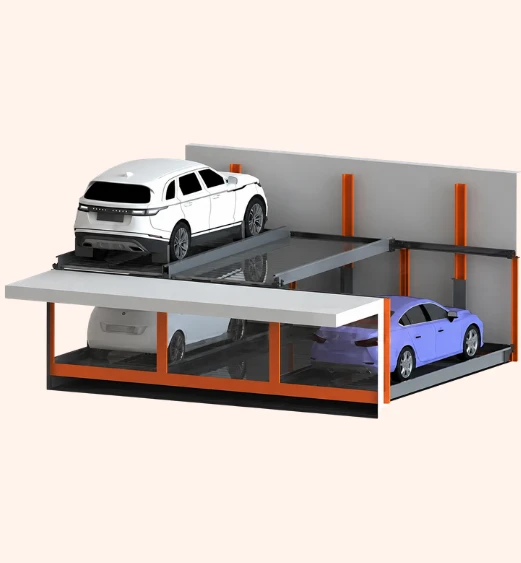
Why Indian Projects Need an Automated Parking System
Almost nobody starts looking for automated parking solutions because the technology is interesting. They start because a drawing does not add up. The sanctioned plan promises a certain number of car spaces, the plot cannot hold them, and until those cars physically fit, the project does not move.
The ECS count is short
Local norms fix how many equivalent car spaces a building owes. Fall short and the file stalls — an automated parking system adds the missing slots inside the same footprint, without redrawing the tower.
BU permission is on the clock
Occupancy cannot be handed over until the parking on site matches the parking on paper. Every week of delay is carrying cost on finished flats nobody can move into.
Land is the most expensive part
An open parking bay eats roughly 25–30 m² once the driving aisle is counted. Stacking cars keeps that area saleable instead of surrendering it to a ramp.
What is an Automated Parking System?
An automated parking system is a mechanical car parking system in which the machine moves the car instead of the driver. Cars sit on steel platforms lifted, lowered or slid sideways by motors, hydraulics, chains or lifts. Nobody drives between the parked cars, so the layout needs no aisles, ramps or door-opening gaps. The same plot then holds two to six times more cars.
The term covers a wide range — a semi-automatic system where the driver still parks on the platform, and a fully automatic car parking system where machinery does everything. Both are correctly called an automated car parking system, which is why supplier quotes look so far apart. For a developer, basement and stilt parking is usually FSI-exempt, so mechanising it protects saleable area while still meeting the sanctioned car count.
Semi-Automatic vs Fully Automatic Parking Systems
Both are engineered and both are safe. The difference is who puts the car on the platform — and that changes cost, civil work and retrieval time.
The driver parks
Semi-Automatic Parking Systems
The driver parks on the platform and walks away. The machine lifts or shifts it. Stack, pit, puzzle and suspended systems.
- Lowest cost per car space
- Little or no civil work
- Retrofits into an existing basement
- 2–6 cars in the footprint of one
The machine parks
Fully Automatic Parking Systems
The driver leaves the car in an entry bay. Lifts and shuttles do the rest. Tower and rotary systems.
- Highest cars per m² — 8–16× on our rotary
- Towers up to 70 m above ground
- No driving, so no scrapes
- Designed in from the start
| Criteria | Semi-Automatic | Fully Automatic |
|---|---|---|
| Who moves the car in | The driver, onto a platform | The machine, from an entry bay |
| Cost per parking space | Lower | Higher |
| Space efficiency | 2–6 cars per bay footprint | Highest — 8–16× on a rotary system |
| Civil work | Minimal above ground; pit versions need excavation | Designed structure, entry bay and foundation |
| Retrofit into an existing building | Yes, commonly done | Rarely — usually planned at design stage |
| People inside the parking area | Yes | No — safer and more secure |
| Typical i-CUBE systems | Stack, pit, puzzle, suspended | Tower, rotary |
| Best for | Residential, societies, homes | Premium, commercial, very tight plots |
Book a Free Parking Consultation
Most projects end up with a mix — semi-automatic in the basement, a fully automatic tower where the plot narrows. i-CUBE builds both, so the advice is about your site, not our stock.
- A layout feasibility check on your drawing
- How many cars your plot can actually hold
- The right system, and a line-item quote
How Does an Automated Car Parking System Work?
The sequence below describes a fully automatic system, where the machine does everything. A semi-automatic system follows the same logic, except the driver performs step one by parking on the platform himself.
Car enters the bay
The driver stops on the entry pallet, switches off, and everyone gets out. A turntable can rotate the car so it later drives out facing forward.
The system measures the car
Sensors check length, width and height and confirm nothing is outside the platform limits. If a door is open or a person is still inside, nothing moves.
A slot is assigned
The control system picks a free space that matches the vehicle size — a hatchback does not get given an SUV bay — and records it against your card, code or number plate.
Lifts and shuttles carry the car
The platform travels vertically on a lift, then horizontally into position. In a rotary system the whole carousel turns instead, powered by a single motor.
Locks hold the load
Mechanical locks take the weight once the platform stops. The car rests on steel, not on pressure or on a motor holding position.
Retrieval on one command
Enter your code at the panel and the automatic car parking system brings the car back to the exit bay, usually in one to three minutes depending on system size.
Access, slot allotment and reporting can all be handled through a parking management system, with IoT-based monitoring for live status and fault alerts.
Types of Automated Car Parking Systems
These are the automated parking systems i-CUBE manufactures and installs across India, grouped by the decision above. Not sure which one your plot can take? That is what the free site assessment is for.
Semi-Automatic Systems
Driver parks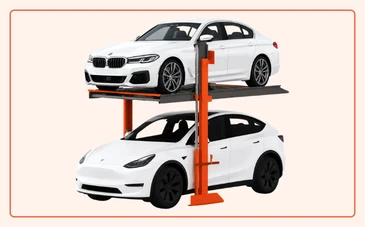
Stack Parking System
The simplest way to double a bay. One car is lifted so a second parks underneath, in two or three levels.
- 2 or 3 cars in one bay
- Dependent or independent
- Best cost per slot
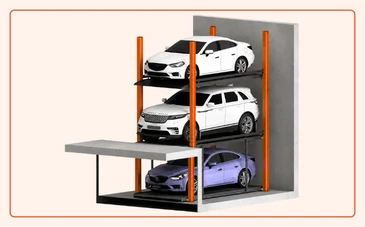
Pit Parking System
Platforms drop into an excavated pit so extra cars sit below ground and nothing is added above the plot line.
- No added height above ground
- 2 and 3 level versions
- Suits height-capped sites
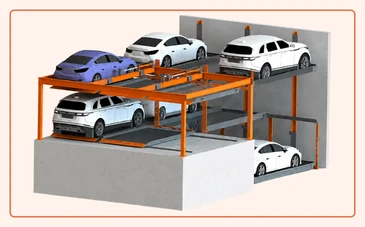
Puzzle Parking System
Platforms move up, down and sideways like a sliding puzzle, so any car can be taken out on its own without shifting another.
- Independent retrieval
- Highest cars per m² in this group
- For larger car counts
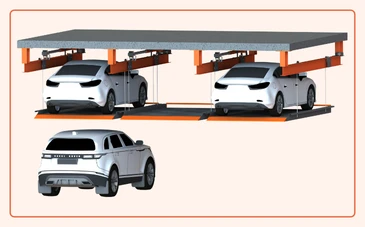
Suspended Parking System
The platform hangs from the ceiling or a frame instead of standing on posts, keeping the floor clear where column spacing is tight.
- Ceiling type and frame type
- Keeps the floor free
- Good for basement retrofits
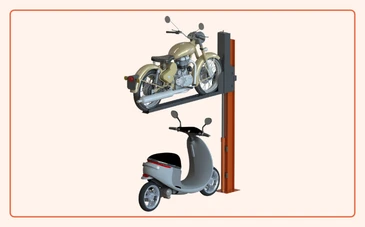
Two-Wheeler Parking System
The same principle sized for scooters and bikes, in single and group versions plus a carousel option.
- Very small footprint
- Single and group versions
- Quick to install
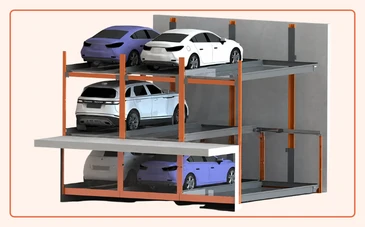
Customised Parking Solutions
Odd column grids, low headroom and irregular plots rarely suit a catalogue product. These are engineered to the drawing.
- Built to your layout
- Mixed configurations
- Survey-led design
Fully Automatic Systems
Machine parks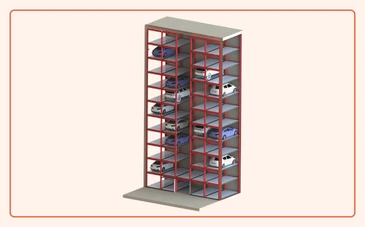
Tower Parking System
A fully automatic vertical tower on the smallest possible footprint. An automated multilevel parking system in the truest sense — cars are lifted to a level and slid into place by the machine.
- Up to 70 m above ground, 10–15 m below
- 2 T / 2.5 T per vehicle
- Open, closed and RCC tower versions
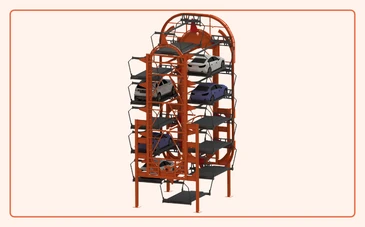
Rotary Parking System
A vertical carousel driven by a single motor, turning either way to bring the requested car to the door. Indoor or outdoor.
- 8–16× conventional capacity
- 12 SUVs at 2,000 kg or 14 sedans at 1,800 kg
- Shortest-path retrieval logic
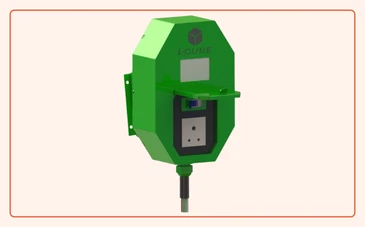
EV Charging & Controls
Charging points, access control and slot management fit into either group, so the parking works as one system rather than three suppliers.
- Parking-integrated EV chargers
- Prepaid and managed charging
- Access and reporting software
Want the whole picture first? See the full mechanical parking system range, or browse parking accessories.
Features of Our Automatic Car Parking Systems
The most common objection we hear is not price. It is “what happens the day it stops working, with my client’s car inside?” These are the things that answer it.

Anti-Fall Mechanical Locks
Steel locks carry the load once a platform stops. The car never hangs on pressure alone.

Photo-Electric Sensors
Movement stops the instant anything crosses the platform path.

Safe in a Power Cut
Nothing drops. Platforms stay locked, and a manual procedure brings a car down if needed.

PLC Control Panel
Push-button, card or code operation with overload protection and emergency stop.

Vehicle Size Detection
On fully automatic systems the machine measures the car and assigns a slot that fits it.

Nobody Walks Inside
In a fully automatic system there is no public access to the parking area — no theft, no door dings.

Sized for Sedans and SUVs
Platform width, height and capacity are chosen for your project’s actual car mix.

Galvanised Anti-Slip Platforms
Corrosion-protected decks built for basement damp and monsoon conditions.

Made to Your Layout
Column spacing, headroom, floor loading and ramp position are measured before anything is built.


In-House Service + AMC
Preventive servicing on a schedule under an AMC plan run by our own engineers.
Automated Parking System vs Traditional Parking
Traditional parking is not cheaper. It only looks cheaper, because the land it consumes was bought long before anyone priced a machine.
| Criteria | Automated Parking System | Traditional Parking |
|---|---|---|
| Area per car | Roughly a third to a sixth | 25–30 m² including the aisle |
| Ramps and driving aisles | Not needed | Consume a large share of the floor |
| Cars on the same plot | 2–6× more, and higher in a tower | Baseline |
| Time to build | Weeks to a few months | Months of civil construction |
| Vehicle damage | Low — little or no manoeuvring | Scrapes and dings are routine |
| Security | Cars enclosed, restricted access | Open floor, general access |
| Emissions inside the building | Minimal — engines are off | Cars idle and circle looking for a bay |
| Maintenance | Scheduled servicing and AMC | Sweeping and lighting only |
| Upfront equipment cost | Real, and quantifiable | None — the cost was the land |
Automated Parking System Cost in India
Search for an automated parking system cost and the published figures run from well under ₹1 lakh for a basic stacker slot to ₹15 lakh and beyond per car for a shuttle-based system. Every one of those numbers is real, and none of them is yours. Anyone quoting a per-slot rate before seeing your site is guessing. Seven things decide the number:
Level of automation
Semi-automatic or fully automatic is the single biggest lever, ahead of everything else on this list. Decide this first.
Type and levels
A two-level stacker, a puzzle grid and a tower are different machines entirely. Level count then sets the base price within a type.
Number of car spaces
Cost per slot falls as the count rises. Shared lifts, panels and structure spread across more cars.
Dependent or independent
Dependent systems cost less but the front car must move first. Independent retrieval adds mechanism, and price.
Civil work and site conditions
Pits need excavation, waterproofing and drainage. Headroom, column spacing, floor loading, power supply and water table all change what is buildable.
Retrieval speed and car mix
A commercial building needing fast turnaround, or a project full of heavy SUVs, needs more steel and more drive capacity.
Scope, controls and AMC
Supply only, or turnkey with civil work, access controls, EV charging and commissioning — plus the maintenance cover after handover.
Our promise: we do not quote a per-slot rate over the phone. You get a site visit and a line-item BOQ, so the automated parking system cost you plan with is the one you build with.
Request My Detailed QuoteWhere Automated Parking Systems Are Used
An automated car parking system earns its place anywhere the car count is higher than the floor area allows. These are the buildings where our automated parking solutions add the missing slots without buying more land:
- Residential projects and towers
- Developer sites needing ECS / BU compliance
- Housing societies and stilt retrofits
- Commercial complexes and offices
- Malls and mixed-use developments
- Hotels, hospitals and clinics
- Car showrooms and service centres
- Bungalows, villas and private homes
Not sure how many cars your basement can actually take? Our parking consultancy team studies demand, norms and layout before any machine is proposed — including car parking simulation and parking planning and design.
Why Choose i-Cube Parking Elevators?
Precision engineering, proven safety standards — and a track record you can go and visit before you decide.
We build both, so the advice is honest
Semi-automatic and fully automatic systems are both in our range. We have no reason to push you toward the one we happen to stock.
A manufacturer that thinks like a consultant
Our parking consultancy team studies demand, norms and layout before a machine is ever proposed.
Empanelled with CREDAI
Certificate of Empanelment from CREDAI (2023) — the developer community’s own vetting.
Real projects you can visit
75+ projects and 6,500+ parking spaces across India, including Shivalay Sharnam (808 spaces) and Spectra (600) — see all projects.
One partner from drawing to AMC
Design, manufacture, install, commission and maintain — all in-house, so nobody points at another vendor when something needs fixing.
Service that answers the phone
An in-house Ahmedabad service team and preventive AMC plans, so a breakdown is a call, not a search. See our case studies.
Frequently Asked Questions
What is an automated parking system?
An automated parking system is a mechanical car parking system in which machinery moves the car into and out of its space instead of the driver. Cars sit on steel platforms that are lifted, lowered or slid sideways, so the layout needs no ramps, aisles or door-opening gaps. The result is roughly two to six times more cars on the same plot, and considerably more in a tower.
What is the difference between a semi-automatic and a fully automatic car parking system?
In a semi-automatic system the driver parks on the platform and the machine moves the platform — stack, pit, puzzle and suspended systems work this way. In a fully automatic car parking system the driver leaves the car in an entry bay and lifts, shuttles or a carousel take it to a slot chosen by the control system. Semi-automatic costs less and retrofits easily; fully automatic packs in more cars, keeps people out of the parking area, and needs to be designed in from the start.
How much does an automated car parking system cost in India?
There is no honest flat rate. Published figures for automated parking systems in India range from under ₹1 lakh per slot for a basic semi-automatic stacker to ₹15 lakh and above per car for large shuttle-based systems, because those numbers describe completely different machines. The automated parking system cost for your project depends on the level of automation, system type and levels, number of car spaces, dependent or independent design, civil work, retrieval speed and scope. i-CUBE gives a line-item BOQ after a free site assessment instead of a phone quote.
Is an automatic car parking system safe?
Yes, when it is engineered and maintained properly. Every i-CUBE system uses mechanical anti-fall locks that hold the platform once it stops, photo-electric sensors that halt movement if anything is in the way, overload protection and an emergency stop. On fully automatic systems there is the added safety of nobody walking inside the parking area at all.
How long does it take to get a car back?
On a semi-automatic system, generally under a minute — the platform comes down and you drive out. On a fully automatic system it typically takes one to three minutes depending on the size of the installation and how many cars are being called at once. Peak-hour retrieval is something we model at the design stage rather than leave to chance.
What is an automated multilevel parking system?
It is any automated parking system that stores cars on more than one level. A tower parking system is the clearest example — an automated multilevel parking system that stacks cars vertically on the smallest possible footprint, up to 70 m above ground. Puzzle and pit systems are multilevel too, on a smaller scale.
What happens during a power failure?
Nothing moves and nothing drops. Platforms are held by mechanical locks, so cars stay exactly where they are. Normal operation resumes when power returns, and a manual procedure is available to bring a car down before then. Projects that cannot tolerate any wait usually put the parking on the backup supply.
Can an automated parking system be retrofitted into an existing building?
Semi-automatic systems very often can — stack and suspended systems in particular are designed for exactly this, and many housing societies add them to an existing stilt or basement. Fully automatic systems are much harder to retrofit because they need a designed structure and entry bay. The deciding factors are headroom, column spacing, floor loading and power supply, which is why we survey before quoting.
Does an automatic car parking system need an attendant?
Not for the machine to work. A semi-automatic car park system is operated by the residents themselves with a button or key. Fully automatic systems run on card, code or number-plate recognition. Larger commercial installations often keep an attendant at peak hours for traffic flow, not because the system requires one.
What is an automatic smart car parking system?
“Smart” usually refers to the software layer rather than the mechanics — an automatic smart car parking system pairs the mechanical system with access control, slot allotment, number-plate recognition, live occupancy data and remote fault alerts. i-CUBE supplies this through our parking management system and IoT-based parking solution, on either semi-automatic or fully automatic equipment.
Do you supply automatic car parking systems in India outside Ahmedabad?
Yes. i-CUBE has created 6,500+ parking spaces across India, with manufacturing and service headquarters in Ahmedabad, Gujarat. Every automatic car parking system in India that we supply is installed and serviced by our own engineers rather than handed to a local dealer. When you compare automated car parking system manufacturers, ask each one where its nearest service engineer actually sits — that is what decides how quickly a stopped machine starts again.
How much maintenance does an automated parking system need?
Scheduled preventive servicing, typically a few visits a year depending on system type and usage — lubrication, sensor and lock checks, control panel inspection and a load test. It is covered under an AMC plan handled by our own engineers rather than a subcontractor.
Looking for automated car parking system manufacturers in India who survey before they quote?
Talk to i-CUBE Parking Elevators for a free site assessment, a layout feasibility check and a line-item quote you can plan around.
Tell Us About Your Parking Project
All fields are required.