
Pit Parking System in India — Park More Cars Below Ground
i-CUBE builds pit parking systems that sink cars into an excavated pit, so two or three cars stack in one bay while the top car stays at plinth level. You gain the ECS count your project owes — without adding visible height — and BU permission stays on schedule. We assess your site first, then give you a number you can trust.
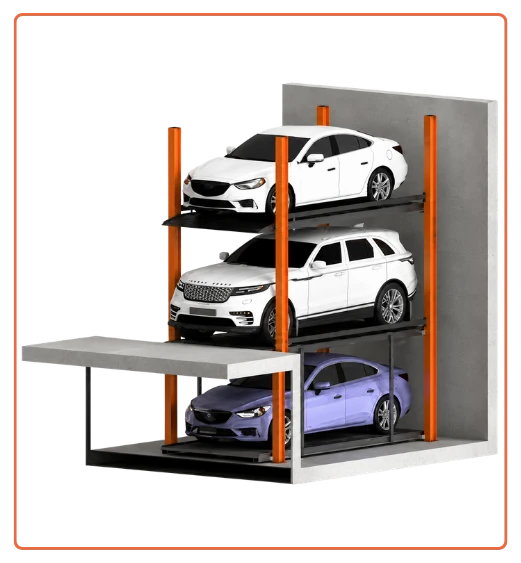
What is a Pit Parking System?
A smarter way to multiply parking capacity in the same footprint — engineered, installed and supported end-to-end.
A pit parking system is a mechanical parking setup where the lower car platforms drop into an excavated pit below the ground. Because one or two levels sit underground, cars stack two or three high in a single bay while the top car stays level with the plinth. That is the difference between a pit system and a normal above-ground stacker: you get the extra parking levels without the extra height above ground.
For developers and builders, that means one surface slot becomes two or three stacked slots — the simplest way to meet a sanctioned ECS count on a plot with a height cap, a podium, or a basement. It is also why pit systems suit premium low-rise and elevation-sensitive projects, where a tall parking tower is not an option. We have used pit parking to clear approvals under deadline — see the Kshitij Aria pit-parking BU-permission project.
How Does a Pit Parking System Work?
From first site visit to final commissioning — a clear, managed path.
Drive onto the platform
The driver parks on the platform sitting at ground level — no ramps into the basement — and walks away.
Sensors check & lock
Position sensors confirm the car sits within limits; safety locks engage before any movement starts.
The platform lowers into the pit
Hydraulic or electro-mechanical drives lower the loaded platform into the excavated pit below ground.
The next car parks on top
A second platform rises into the ground-level position, ready for the next car — two or three cars now share one bay.
Locks hold every level
Mechanical locks hold each raised and lowered platform in place, so no car sinks or drifts, even without power.
Recall in one command
Enter the slot; the platform lifts out of the pit and delivers the car back to ground level, ready to drive out.
Features of Our Pit Parking System

One or two levels sink into the pit, so capacity grows underground, not upward.

The top platform stays flush with the ground — no added height above the plot.

Two-level and three-level pit configurations multiply slots on the same footprint.

Choose independent retrieval, or a simpler dependent stacker to lower cost.

Hydraulic for smooth, quiet strokes — or electro-mechanical for high-frequency duty.

Mechanical locks hold every platform, even in a power failure.

All movement stops the instant anything crosses the platform path.

Pit lining, sump and drainage are engineered in to keep the pit dry.

Corrosion-protected decks that shield cars in basement and monsoon conditions.

Platform capacities and heights sized to your project’s car mix.


Types of Pit Parking System
Every plot gets a different answer. These configurations cover simple two-car bays, three-level pits, and grid-style pit systems for larger counts. Not sure which fits your site? Start with the cards, or ask our engineers.
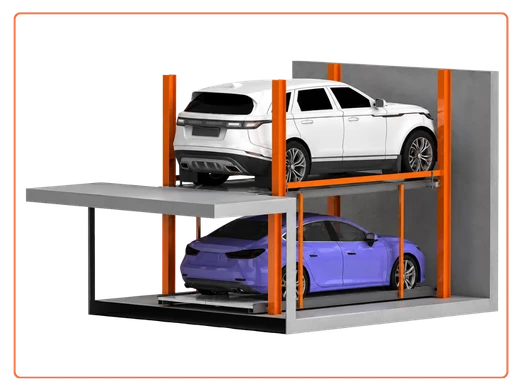
2 Level Pit Parking System
The entry-level pit bay: one car parks at ground level, one sits in the pit below — doubling a slot with no added height.
- G+1 below-ground (2 cars per bay)
- Top car stays at plinth level
- Ideal for villas, low-rise and stilt retrofits
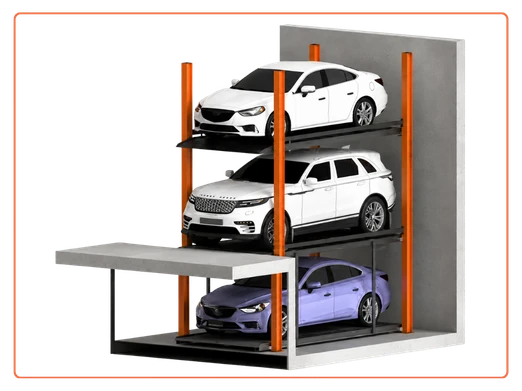
3 Level Pit Parking System
Two levels sink below grade for triple capacity, with almost nothing visible above the plinth line.
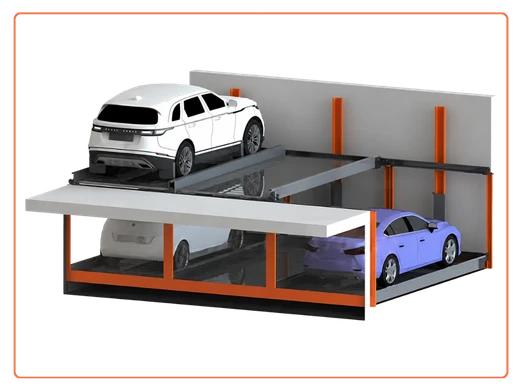
2 Level Pit Puzzle Parking System
A pit puzzle parking system adds sideways shuffle to the pit, so every car is retrieved independently — with the top row flush at ground level.
- Independent retrieval, no car-shuffling
- Top pallets sit at plinth level
- Best for height-capped mid-size counts
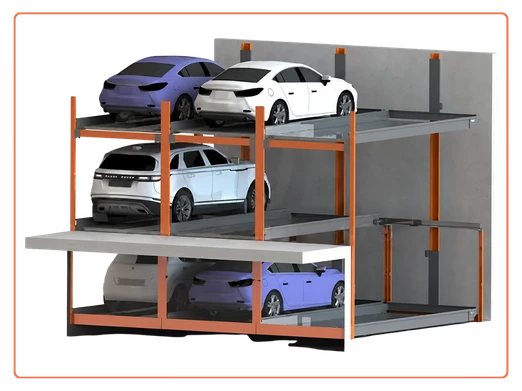
3 Level Pit Puzzle Parking System
Two grid levels below grade for triple capacity with independent retrieval — maximum density with zero visual bulk above the plinth.
- Triple capacity, nearly invisible
- Suits premium and heritage-sensitive sites
- Waterproofing & drainage engineered in
Comparing categories first? See our stack parking system and puzzle parking system ranges, or start from the full mechanical parking system overview.
Applications of the Pit Parking System
Wherever height is limited but a car count still has to be met — pit parking keeps the extra slots underground:
Pit Parking System vs Traditional Parking
| Criteria | Pit Parking System | Traditional Parking |
|---|---|---|
| Added height above ground | None — extra cars go below the plinth | Needs ramps, floors or a tower |
| Parking capacity | 2× to 3× per bay on the same plot | Fixed by available land |
| Space required | Minimal footprint; capacity added underground | Large land area per car |
| Suits height-capped sites | Yes — keeps parking out of sight | Limited by bye-law height |
| Installation time | Weeks once the pit civil work is ready | Months of construction |
| Cost per slot | Lower than excavating extra basement floors | High land + civil cost per slot |
| Maintenance | Scheduled AMC visits | Sweeping, lighting & security overheads |
Pit Parking System Cost in India
Anyone quoting a pit parking system price before seeing your site is guessing. Two projects with the same car count can budget very differently — because the pit itself is part of the cost. These six factors decide your number:
A 2-level pit budgets differently from a 3-level pit or a pit puzzle grid — the level count sets the base price.
Excavation, retaining, lining, waterproofing and drainage for the pit are a real part of a pit-system budget.
A dependent pit stack costs less; independent retrieval adds mechanism and cost.
Hydraulic and electro-mechanical drives carry different equipment and running costs.
Water table, soil, foundation loads, power supply and column spacing all affect the pit design.
Supply-only vs turnkey with civil work, plus the maintenance coverage you choose.
Our promise: for any serious project, a site visit and a line-itemised BOQ are the only reliable numbers — not a per-slot teaser that grows once the pit is priced in. Start rough with our parking space calculator.
Why Choose i-Cube Parking Elevators?
Precision engineering, proven safety standards — and a track record you can visit before you decide.
Our parking consultancy team studies demand, norms and layout before any machine is proposed.
Waterproofing, drainage and anti-fall locks on every pit system — because a pit is judged on the day it floods or loses power.
2-level, 3-level, pit stack and pit puzzle systems engineered to your plot — not a one-size catalogue.
Certificate of Empanelment from CREDAI (2023) — the developer community’s own vetting.
Pit parking cleared BU permission at Kshitij Aria; 75+ projects and 6,500+ spaces nationwide — see all projects.
An in-house Ahmedabad service team and preventive AMC plans keep uptime a promise, not a hope.
Frequently Asked Questions
A pit parking system is a mechanical parking system where the lower car platforms sit in an excavated pit below ground. One or two levels go underground so cars stack two or three high, while the top car stays at ground level — you add parking capacity without adding height above the plot
There is no honest flat rate — the pit parking system price in India depends on levels, pit depth and civil work, dependent vs independent design, drive type and site conditions. i-CUBE quotes a line-itemised BOQ after a free site assessment, so the number you plan with is the number you build with
A 2-level pit parking system puts one car at ground level and one in the pit (two cars per bay). A 3-level version sinks two levels below grade for three cars per bay. It needs a deeper pit and more waterproofing, so it is chosen where the car count justifies the extra civil work
A pit stack parking system is a stacker that uses a pit level to add a car in a fixed column. It is the simplest and most economical pit option. Pit stack parking comes in dependent versions (the ground car moves first) and independent versions (each car is reachable on its own)
Not when the pit is built correctly. i-CUBE engineers pit lining, a sump and drainage into every pit system to keep it dry, and waterproofing is scoped in the civil BOQ
Cars stay locked on mechanically held platforms — they do not sink in the pit or drift. Retrieval resumes on power restoration, and manual-lowering procedures plus optional backup supply cover emergencies
Both are available. A dependent pit stack is cheaper but the ground car must move before the lower one is reached. An independent or pit puzzle system lets every car in and out on its own — worth the extra cost where daily turnover is high
It depends on the pit civil work — excavation and waterproofing must be ready before the equipment goes in. Once the pit is prepared, erection typically takes weeks, and you get a committed schedule with the BOQ
Yes — i-CUBE has created 6,500+ parking spaces across the nation, with its manufacturing base and service headquarters in Ahmedabad. When comparing pit parking system suppliers in India, ask each one where its nearest service team actually sits
Looking for pit parking system manufacturers in India with a proven track record?
Get in touch with i-CUBE Parking Elevators for a free site assessment and a customised, line-itemised solution.